
How Amin Nasser Leads Aramco When the Biggest Decisions Aren't His
Amin Nasser leads the world's most valuable company but its biggest lever, how much oil the Kingdom pumps, isn't his to pull.
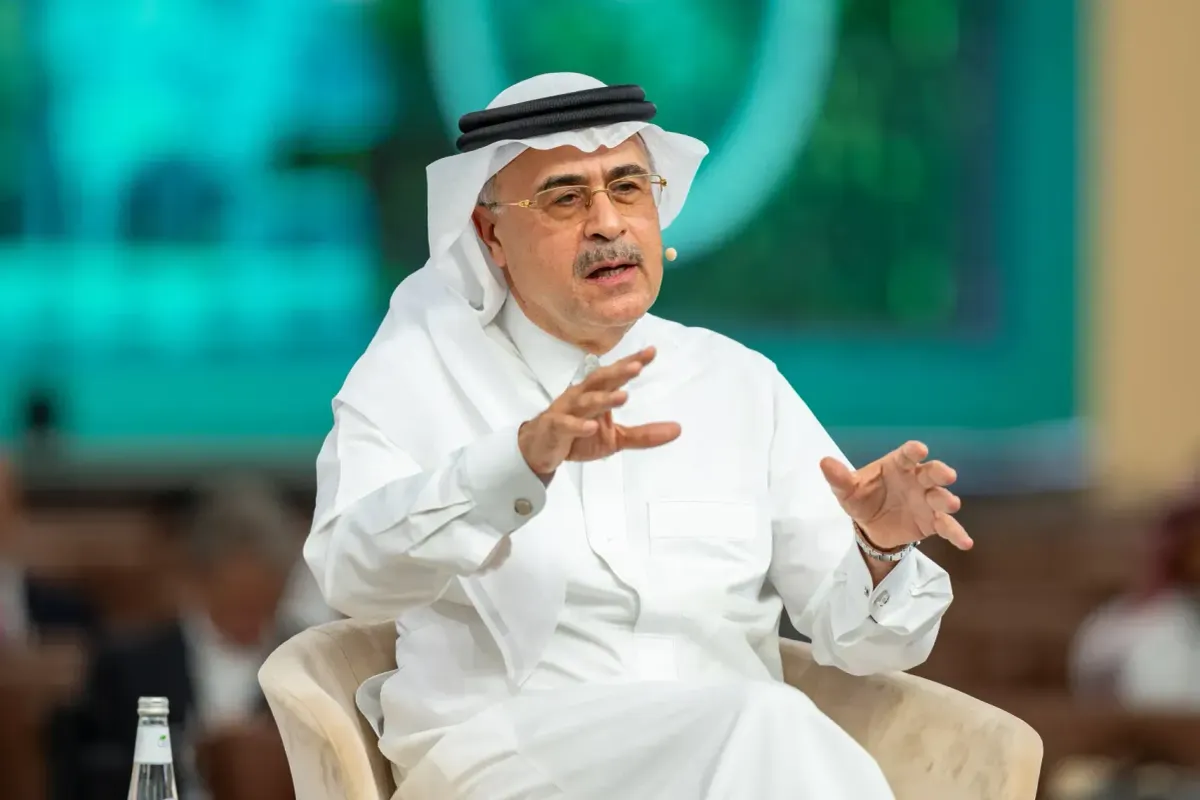
In January 2024, Saudi Aramco told the market it was abandoning a plan it had been executing for nearly four years. The company had been building toward a maximum sustainable production capacity of 13 million barrels per day. Now it would stop at 12 million. The instruction did not originate in Aramco's boardroom. It came as a directive from the Saudi Ministry of Energy, and the company said it did not know the reason.
For most chief executives, reversing a multi-year, multi-billion-dollar expansion would be the defining crisis of a career. For Amin H. Nasser, it was a reminder of the boundary that runs through his job. He leads the most valuable company the public markets have ever priced. But the single most consequential number it produces — how much oil the Kingdom is willing to pump, and how much capacity it is willing to hold in reserve — is not his to set.
Nasser has been President and CEO of Aramco since 2015, and a member of its board since 2010. Understanding him means resisting the easy version of the story, in which the head of the world's largest oil producer is simply one of the most powerful executives alive. The more accurate and more interesting question is narrower: inside a company whose strategic direction is steered by the state, where does a CEO's authority actually operate — and what has he done with it?
The Engineer Who Spent Four Decades Getting Here
Nasser has worked for one company his entire professional life. He joined Aramco in 1982, straight out of the King Fahd University of Petroleum and Minerals in Dhahran with a bachelor's degree in petroleum engineering, and started as an engineer in oil production.
What followed was not a fast track but a long one through the technical core of the business. He held assignments in drilling and reservoir management, became manager of the Ras Tanura producing department in 1997, and later ran producing operations in the Northern Area and the Safaniya offshore and onshore fields — some of the largest in the world. He was named chief petroleum engineer in 2004 and rose to Senior Vice President of Upstream in 2008, the role in which he oversaw the company's largest capital program.
This background matters because it shapes the kind of leader he is. Nasser did not arrive from finance, consulting, or government. He came up through the parts of Aramco that find, drill, and produce oil, and his public arguments consistently return to the physical and economic realities of supply rather than to strategy in the abstract. When he succeeded Khalid A. Al-Falih as acting chief executive in May 2015, and permanently that September, the company was handing its top job to someone who had spent more than thirty years learning how its oil actually comes out of the ground.
Putting a Price on the World's Best-Kept Secret
The most visible event of Nasser's tenure was the one that ended decades of secrecy. In December 2019, Aramco listed a 1.5% stake on the Saudi exchange, Tadawul, in the largest initial public offering in history. It raised $25.6 billion — rising toward $29.4 billion once an over-allotment option was factored in — and valued the company at roughly $1.7 trillion, making it the most valuable listed company in the world.
It is important to be precise about what this was and was not. The decision to take Aramco public belonged to the state, and specifically to Crown Prince Mohammed bin Salman, who first floated it in 2016 as a way to fund the Public Investment Fund and, through it, Vision 2030. The $2 trillion valuation the leadership had targeted was not reached, and international institutional investors largely stayed away, leaving the deal to be carried by domestic and Gulf demand.
What can reasonably be attributed to Nasser and his team is execution. Listing a company that had operated as a closed state entity for four decades required opening its books, submitting to quarterly disclosure, and building the investor-relations machinery of a public company. That transformation — from a guarded national asset into a company that reports its cost of production and defends its numbers on earnings calls — is the operational achievement, and it happened on his watch.
Building the Parts of Aramco the State Doesn't Steer
If production levels are set above the CEO's head, Nasser's actual domain is everything else: cost, reliability, capital allocation, and the deliberate widening of Aramco beyond the crude oil business that made it. This is where his fingerprints are clearest.
A $69 Billion Deal That Stayed Inside the Family
In 2020, Aramco completed the acquisition of a 70% stake in SABIC, the Saudi chemicals group, for roughly $69 billion. It was one of the largest deals in the sector, but its structure is revealing: Aramco bought the stake from the Public Investment Fund, the same sovereign fund that the IPO was designed to capitalize.
In effect, a state asset moved onto Aramco's balance sheet, and the cash helped fund the Kingdom's diversification elsewhere. The deal genuinely deepened Aramco's push downstream into chemicals — turning more of its own hydrocarbons into higher-value products — but it is better understood as strategic coordination between arms of the Saudi state than as an independent piece of dealmaking.
The Bet on Gas
The clearer expression of Nasser's own strategy is gas. Aramco is targeting an increase in sales gas production capacity of around 80% by 2030 against 2021 levels, anchored by the Jafurah field — the Kingdom's largest unconventional gas development — and new processing capacity such as the Tanajib Gas Plant.
The logic is a hedge against the one uncertainty Nasser cannot control: the long-term trajectory of oil demand. Gas, chemicals, and downstream expansion give Aramco value that does not depend solely on how many barrels of crude the world burns, and they are the areas where a CEO can build without waiting for a directive.
The financial base under all of this is unusually solid. Aramco's oil extraction cost is roughly $2 per barrel of oil equivalent, among the lowest in the industry, which is why the company remained enormously profitable even as earnings fell from the $161.1 billion record of 2022 to $121.3 billion in 2023, $106.2 billion in 2024, and an adjusted $104.7 billion in 2025. That resilience is structural — a function of geology and cost — as much as it is managerial, and Nasser is careful, in his own words, to credit "lower-cost, adaptable, and highly-reliable operations" rather than any single decision.
The Decision That Wasn't His to Make
Return to the capacity reversal, because it is the sharpest illustration of how this company is actually run. In March 2020, Aramco had been directed to raise its maximum sustainable capacity to 13 million barrels per day. In January 2024, it was told to stop and hold at 12 million — with no public explanation, and with the acknowledgment that the change reflected neither a technical problem nor a shift in the company's own demand forecast.
Analysts read it as a signal that Riyadh was less confident that the world would need the extra supply, and that the capital was better spent elsewhere. Whatever the reason, the episode drew the boundary in plain view: the ceiling on Aramco's core business is a policy instrument of the Saudi state, not a call made by its management.
This is the context in which Nasser's leadership has to be judged. He does not get to decide how much oil Saudi Arabia produces, when it cuts through OPEC+, or how large a reserve of spare capacity it holds. What he decides is how efficiently, how cheaply, and how reliably the company operates within those limits — and how it positions itself for a future that its majority owner is actively trying to change.
Why He Tells the World Oil Isn't Going Away
There is one arena where Nasser is unmistakably in charge: the argument. Over the past few years he has become the industry's most prominent public defender of continued investment in oil and gas, and he makes the case more bluntly than most of his peers dare to.
At the CERAWeek conference in Houston in March 2024, he said the quiet part aloud, to applause from a room full of oil executives:
"We should abandon the fantasy of phasing out oil and gas and instead invest in them adequately reflecting realistic demand assumptions."
He argued that the energy transition was "visibly failing on most fronts," pointing to a set of numbers he returns to often: that despite roughly $9.5 trillion invested in alternatives over two decades, wind and solar still supplied under 4% of global energy, and the hydrocarbon share of the energy mix had barely moved, from about 83% to 80%.
The significance of the statement is not that it is pro-oil — one would expect that from the head of Aramco. It is the framing. Nasser is not defending oil as a necessary evil to be managed down; he is challenging the premise that a rapid phase-out is realistic at all, and telling policymakers their timeline is wrong. That is a deliberate rhetorical position, and it has made him the executive most identified with the view that peak oil demand is further away than the International Energy Agency projects.
It also sits in an unresolved tension with the country he serves. Saudi Arabia's own Vision 2030 is built on the premise that the Kingdom must diversify beyond oil, and Aramco's dividends — more than $124 billion paid in 2024, the majority flowing to the state — are among the instruments funding that diversification. Nasser leads the company arguing most forcefully that oil has a long future, while its profits underwrite his own government's effort to depend on it less.
What Comes Next
The interesting question about Amin Nasser is not what he will build next, but which version of him the decade rewards. If global oil demand keeps climbing toward the records he predicts, he will be remembered as the executive who refused to apologize for the business and kept it disciplined and cheap enough to win. If demand turns earlier than he expects, his gas, chemicals, and downstream bets — and his willingness to move Aramco beyond crude — will matter far more than his speeches.
Either way, his tenure has already answered the question it raised at the start. Leadership at Aramco is not about controlling the company's biggest lever, because that lever belongs to the state. It is about everything that happens inside the boundary the state draws: keeping the world's most profitable company the lowest-cost and most reliable in its field, hedging quietly against a future its owner is chasing, and speaking plainly about an industry most of its leaders would rather discuss in euphemism.
That is the paradox worth remembering about Amin Nasser. He runs a company whose direction he does not fully set — and he has made the management of that constraint, rather than the illusion of unlimited power, the substance of his leadership.