
The Systems Engineer Who Decided People Were the Hardest System to Build
Discover how Omar Najjar, Deputy CEO of Misk Foundation, is building Saudi Arabia’s future leaders through human capital, governance, and Vision 2030 programs.
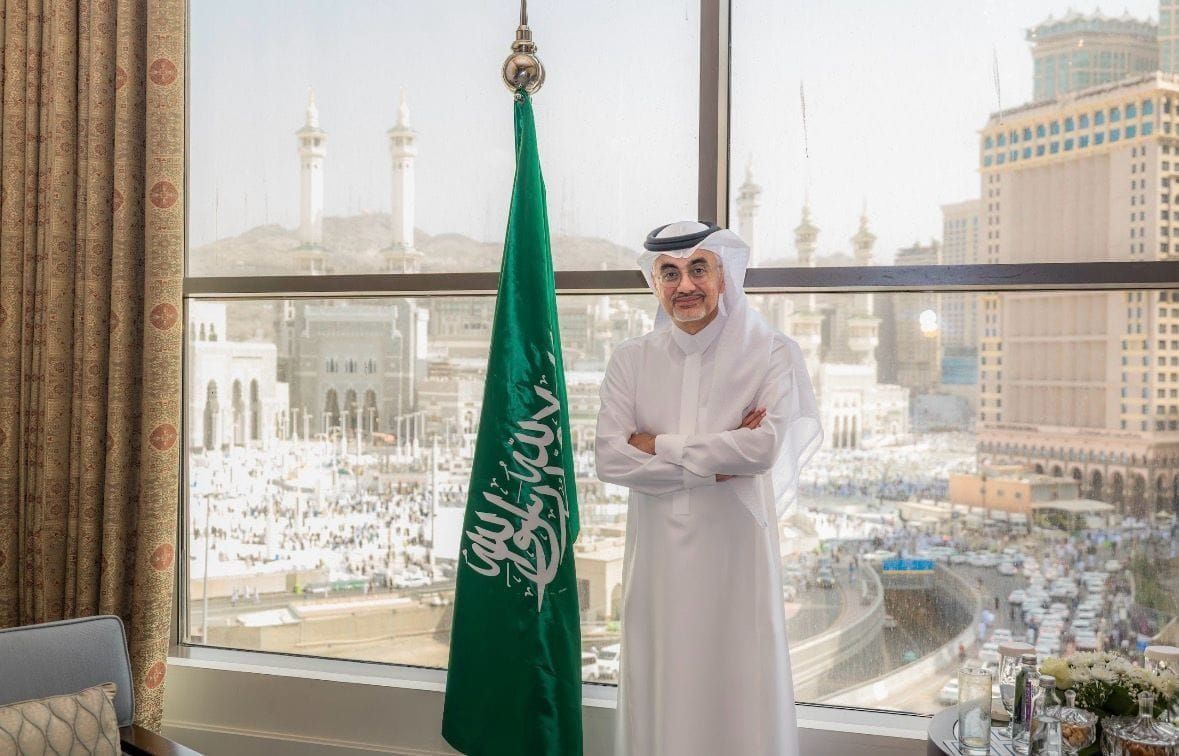
By the time Omar Najjar took command of Saudi Ground Services in 2017, a company that moves tens of millions of travellers through the Kingdom's airports every year, he had already spent two decades doing a specific kind of work: entering large, complicated organizations and making them run better.
The more revealing decision came next. After barely seventeen months running one of the country's largest service operations, he left operational command behind and joined the Misk Foundation to work on something less tangible and harder to measure: the supply of leaders the Kingdom would need to run everything else.
That move is the key to reading his career. Najjar trained as a systems engineer, and he has spent thirty years applying an engineer's question — how do the parts fit together to produce the whole? — to progressively less mechanical systems. Machines, then processes, then organizations, then people, and finally the question underneath all of them: who is capable of leading, and how do you produce more of them.
An Engineer's Idea of How Organizations Work
Najjar graduated in systems engineering from King Fahd University of Petroleum & Minerals in 1995 — with honors, and, by his own account, sponsored by Saudi Aramco as a top student. He joined Aramco straight out of university through its professional development program. Aramco is where a generation of Saudi executives learned institutional discipline, and it gave him an early education in how a very large system holds together.
In 1997 he moved to Saudi Arabian Airlines for re-engineering and process-improvement work — but the title there paired industrial engineering with human resources, and by his own account it was where his human-capital career began. It was the first sign of a pattern, and of a drift: he was drawn less to running a fixed operation than to redesigning how one worked, and increasingly toward the human part of the machine.
Systems engineering is not really about machinery. It is a way of seeing — treating an organization as a set of interacting parts whose output depends on how well those parts are aligned. That lens would follow Najjar into aviation, consumer goods, industry, education, and eventually national leadership development. The subject kept changing. The question stayed the same.
When Human Capital Became the Job, Not a Support Function
That drift became the whole job at Unilever, which Najjar joined in 2001 and later called the turning point of his career. He entered running services for the Arabia and Gulf region, then moved into human resources — training, management development, recruitment, and graduate programs across the Gulf, Yemen, and Iran.
In 2006 he was given a far larger remit: regional HR director for Africa, the Middle East, and Turkey, a region reported at the time to employ more than 40,000 people, based out of Unilever's office in Durban, South Africa. He was, by his own later account, deeply involved in reshaping Unilever's global HR function and building its shared-services model.
This is where a conviction takes hold that runs through everything he says afterward: that talent is not a support function but infrastructure. In this view, strategy documents do not transform an organization; leadership pipelines, talent systems, and a culture aligned to execution are what determine whether an organization — or a country — can actually absorb change.
It is worth being precise about what that claim is and is not. It is a genuine operating philosophy, consistently expressed across two decades. It is not, on its own, evidence of outcomes. What can be said with confidence is that Najjar chose to build his career on the belief that people systems are the decisive variable — long before "human capital" became a headline priority in Saudi Arabia.
Translating Global Experience Into National Building
In October 2008, Najjar left the multinational world for a distinctly national project. He joined the King Abdullah Economic City development, running the education business unit under Emaar, The Economic City — overseeing schools, higher education, and vocational training inside a city being built from the desert up.
The shift matters. He was no longer optimizing an existing corporation; he was helping stand up institutions where none had existed. It was corporate capability-building repurposed as nation-building.
Building One Cristal
In 2010 he joined Cristal, the titanium-dioxide producer majority-owned by the industrial group Tasnee, as chief human resources officer — and, in the same period, as the person leading its transformation from a national operator into a global one. He drove the development of a single operating model, "One Cristal," that integrated the company's units worldwide, during a stretch in which Cristal became the world's second-largest producer of titanium dioxide. When Tasnee itself decided to transform, Najjar led that program too, alongside McKinsey & Company.
Taking the P&L
In 2015 the people-and-transformation work resolved into direct accountability. Najjar was promoted to Executive Vice President and Head of Tasnee's Downstream Business — moving, in a single step, from chief HR officer to owning a profit-and-loss statement. By his own account the downstream business ran to around SAR 2 billion in annual revenue across a dozen operating units in plastics, energy, metals, and technical services.
This is the most consequential move on his résumé for understanding his range. HR and transformation leaders are usually kept a safe distance from the balance sheet. Najjar went straight from CHRO to P&L ownership in a heavy-industry business — which complicates the easy label of "the people person." He had, by then, been trusted to run the money.
Running One of the Kingdom's Largest Service Operations
In September 2017, Saudi Ground Services — the Tadawul-listed ground-handling company majority-owned within the Saudia group — named Najjar chief executive, effective 25 September, after the previous CEO resigned for personal reasons.
SGS is an operations business at national scale — a publicly listed company present in 27 airports across the Kingdom with a workforce of roughly 11,000 people. By his own account it served more than 100 million passengers and 50 airlines a year; press reporting from the period put the split differently, closer to 80 million passengers and around 100 airlines. Either way, it is precisely the kind of system — many moving parts, low tolerance for failure, national visibility — that Najjar had spent his career learning to read.
In interviews from the period, he described launching an ambitious transformation plan and a revamped strategy, and an intent to broaden SGS beyond ground handling into a wider services company spanning ticketing, passenger services, and hospitality.
Here CEOPHY draws a deliberate line. That a transformation plan was launched during his tenure is documented. His tenure, however, lasted only seventeen months — September 2017 to January 2019 — before he moved to Misk, too short a window to credit him with the multi-year outcomes such a plan was designed to produce. What the SGS chapter demonstrates is not a turnaround delivered, but the level of operation he was trusted to run: one of the most demanding service environments in the country.
How He Thinks About Leadership
At Misk, Najjar's stated philosophy becomes explicit rather than implied. The foundation's leadership model, which he has publicly articulated, rests on three verbs — know, be, and do: understand the traits leadership requires, develop genuine self-awareness, and act with the boldness to create lasting impact.
Describing the aim of Misk's flagship 2030 Leaders program, Najjar framed it as building leaders' "behavioural and intellectual flexibility to drive change."
The phrasing is worth pausing on, because it reveals what he believes leadership actually is. He does not define it primarily as knowledge, charisma, or authority. He defines it as adaptability — the capacity to change one's own thinking as circumstances change. That is, unmistakably, a systems engineer's definition of a leader: a component valuable not for its fixed properties but for how well it responds to the rest of the system.
It also explains the throughline of his career. A man who believes leadership is a buildable capability, rather than an innate trait, will naturally spend his life building the machinery to produce it.
What He Is Becoming Known For
Najjar's reputation is consolidating around a single idea: he is one of the people the Kingdom relies on to manufacture leadership deliberately.
As Deputy CEO of Misk — a role he reached in 2023 after four years as the foundation's chief of programs — he has been central to its leadership architecture. As programs chief he built Misk Academy as a greenfield operation, and developed and launched the 2030 Leaders program, delivered with the business school Esade, which selects high-potential Saudi executives and moves them through a structured journey toward a stated ambition of developing well over a thousand leaders by 2030; earlier cohorts had graduated 180 participants by early 2023. He launched the Saudi Unicorns entrepreneurship program and Misk's tracks in skills, leadership, community, and enterprise. And he is founding chairman of the Saudi Leadership Society, the standing network the programs feed into — designed so that leadership development becomes a continuing membership rather than a completed course.
A second, quieter pattern reinforces the first. Across a decade of board seats — Middle East Paper Company (2018–2025), Bupa Arabia, the Taif and Jeddah health clusters, the Jeddah Development Authority, and Remat Al-Riyadh — nearly every appointment has placed him on a Nomination and Remuneration Committee, several of them as its chair. These are the bodies that decide how institutions select leaders, plan succession, and reward performance. On the boards, as in the programs, he keeps gravitating to the same seat.
Read together, the pattern is coherent to the point of being a signature. Whether inside a program or inside a boardroom, Najjar keeps positioning himself next to the same question: how does an institution choose and develop the people who will lead it? He has, in effect, made succession his subject.
 Ameer Albahouth
What Comes Next
Najjar describes his own mission in a single line: to "raise a generation of leaders equal to Saudi Arabia's ambition." Underneath it sits a specific and testable wager — that the binding constraint on the Kingdom's transformation is not capital, or projects, or technology, but leadership capacity, and that such capacity can be produced on purpose, at scale, through deliberate design.
That is a genuinely open question, and it is the right lens for watching what he does next. Megaprojects announce themselves. A pipeline of leaders reveals itself slowly, over a decade, in the quality of the people running the institutions no one is looking at yet. The results of the work Najjar is doing now will not be legible for years.
Which leaves one idea worth holding onto about him. Most executives are measured by what they built. Najjar has staked the second half of his career on being measured by who he built — a far harder thing to prove, and a far more consequential one if it works.